Tuesday, June 12, 2018

Pedaling Power Plant

I started using a generator hub in 2003, when I bought my Rivendell Atlantis touring bike from Peter White Cycles of Hillsborough, New Hampshire. This model, the original Schmidt Dynamo front hub or SON (Schmidt's Original Nabendynamo) is extremely reliable and has virtually no drag. Works much better in the rain and snow than a bottle generator, which presses against the sidewall of your tire and can be subject to interference from the elements. Made by Wilfried Schmidt Maschinenbau in Tübingen, Germany, it's supposed give at least 50,000 kilometers (31,068 miles) of trouble-free riding before it has to be overhauled. I'm almost there, but I think it has at least one more tour in it. And these hubs are built to last as long as your bike—a lifetime—so don't worry about the $300 price tag.
The hub powers this amazing Supernova E3 LED headlight. This light is bright and will guide your way no matter how dark it is. The only exception to this, I've found, is in former railroad tunnels through hills and mountains. If the tunnel is longer than say 1,000 feet, it's hard to cut through the blackness with anything. I bought the Supernova around 2010 as a replacement for my halogen bulbed E6 headlight from Schmidt. 

Schmidt E6 halogen. Wonderful light but susceptible to getting whacked, protruding as it did off the front of my rack.
The Supernova tucks nicely under the front rack, right behind the tab where the old, vulnerable Schmidt halogen was attached.

The Supernova taillight, also generator-powered, is tiny but mighty.
Up until this year, I also had this Pedal Power dynamo converter which converts the electrical charge from the generator hub into usable DC current. It included a 1000mA cache battery alongside the AC to DC converter (rectifier) so you could wait until camp to charge up your devices. You can supposedly charge any USB 5v device with this charger. It did work with my old flip phone, but when I got sucked into buying an iPhone, I found it wouldn't charge at all. Apparently, the new version, called the Universal iCable, has fixed this issue.  But now, with all the distracted drivers and petulant crazy Trump supporters roaming the roads, I keep my lights on day and night. That drain keeps even the storage battery from charging, at least to where it can be used for anything requiring much power. So, this piece of kit was retired in favor of the new storage batteries on the market. No more charging things directly from my hub, no matter how cool the concept.


Top: my old Pedal Power Vi4  storage battery, 6700mAh of power, and very expensive when I bought it half a dozen years ago. Derided as "somewhat ‘agricultural’ in aesthetic," according to this reviewer, yet it would charge an iPhone 4 times before having to be recharged itself. Now, I use it in my handlebar bag for on-the-fly charging of my phone. For camping, I use this newly-purchased RAVPower Ace 22,000mAh battery pack. A quarter of the price of my old battery, and more than thrice the juice. 

My electrical needs include my camp light, a bluetooth speaker, and my phone. Sometimes I also travel with my iPad, and that, too, can be charged with this bad boy. Let me close by stating this: that we even "need" electronics on a camping trip says something pretty damning about the current state of our culture.

Wednesday, June 6, 2018

Bike Touring Kit (Part 3): Hubba Hubba

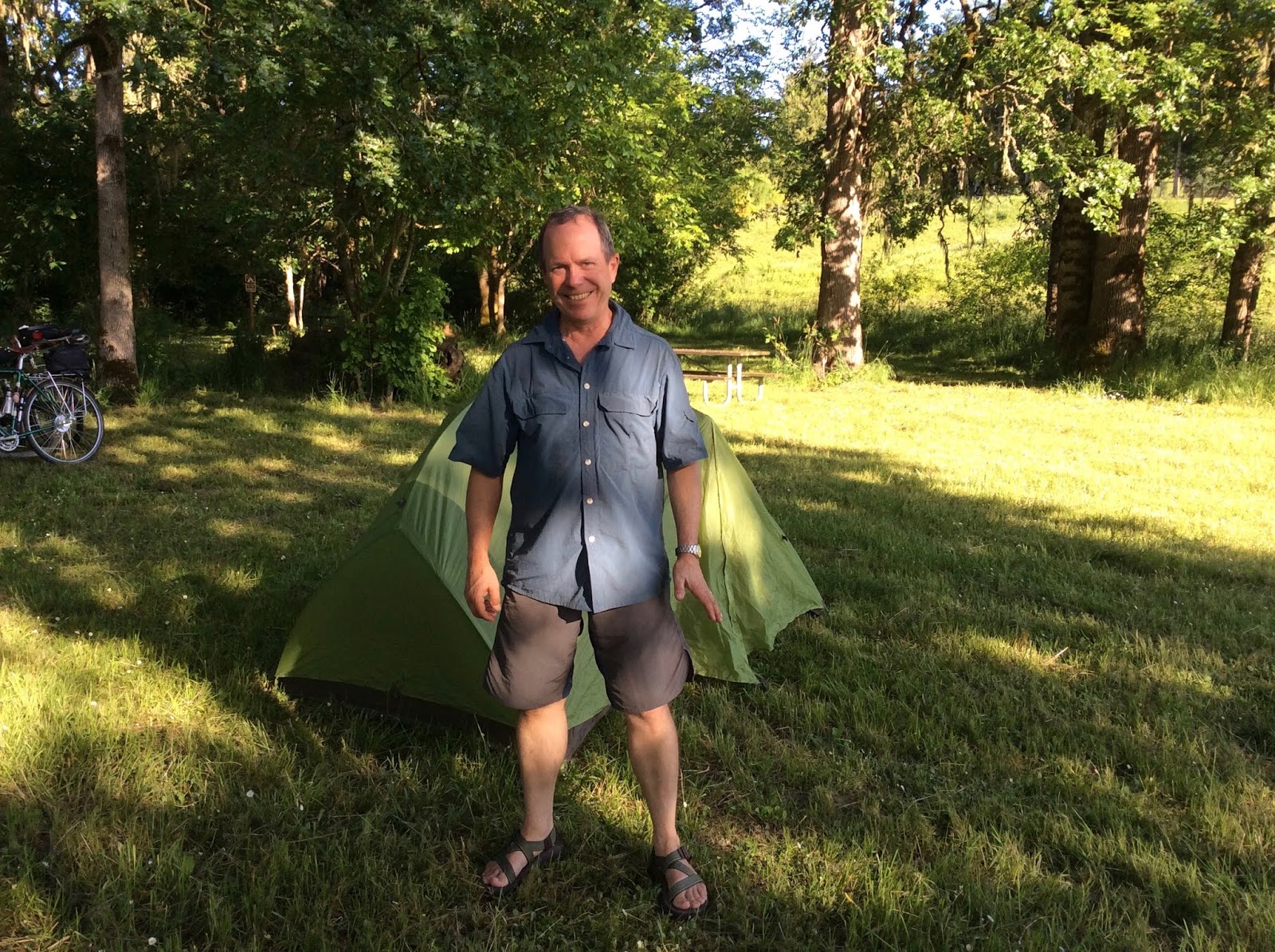
This is it, the best damned bike touring tent I've ever had. Capacious, tall (I can easily “stand up” on my knees inside), and weighing in at just under 2kg. Packed in one rear pannier, with plenty of room left over for a few bottles of craft ale, or a bag of food from a farmers market. It's a wonderful shade of green, one that is found in nature, so if you're tired of peddling for the day, and you're nowhere near an authorized camping spot, it's easy to stealth camp. It's made by MSR of Cascade Designs. I couldn't camp without Cascade Designs (MSR stoves, tents, water filtration), Therm-a-Rest mattresses, Platypus water bags). 


Photo from Tom Allen's site.

I'm not alone in saying this is the best tent for bike touring. Brit Tom Allen conducted an unscientific survey in 2014 that said so as well. Glad I bought mine in 2012 because it is no longer available in this incarnation.
In 2014, they discontinued the Hubba Hubba and replaced it with the Hubba Hubba NX. Half a kilo lighter, and retaining the innovative one-pole hub system. However, it's now a boring old grey color that is supposed to be light neutral inside. Who cares about what the ambient light is while sitting awake in a tent during the day? I want the natural flora green back so I can disappear into a national forest or someone's farm. As for the weight reduction by almost a third, my bike fully loaded weighs over a hundred pounds. Who cares about a mere pound. I simply imagine the old tent will be about a third more durable.
This is the innovative "one pole" design that uses a series of hubs that combine to make a one-piece frame. Quick and easy to set up (10 minutes, tops), well, except for that one time in 2015 while touring in Colorado. We stopped for a couple pints of strong ale at Elevation Beer Company in Poncha Springs to wash down the edibles we brought with us from Denver. I think we stumbled around for an hour before we made camp that day. On a clear, hot night, leave the fly off and enjoy the stars. If the weather is nasty, stay nice, dry and cozy with your gear close by in the two spacious vestibules on either side. Two doors as well on this puppy.


Champoeg State Park, Oregon tour, 2014.

Sunday, June 3, 2018

Dam Side Distraction


Not being in a particularly good place to hike, I generally just bike for exercise while in Iowa. Never been a runner (doesn't go well with my body type, personal ambitions, or need for interesting activities), but my sister Susy, a long-time Dam to Dam proselytizer managed, after registrations were closed, to get three family members into the last real Dam to Dam 20k race. So I'm stuck with a commitment to an activity I find boring at best, and dangerous at worst: running. But I am a hiker and so I figured it would be no big deal to walk this race at my fastest hiking/walking pace of around 4 mph (approx. 15 miles per mile) despite zero training for it. Really pretty stupid. I was able to maintain that pace but I did short myself on the water, which I carried with me in spite of a plethora of water stations. I cramped up the last two miles but managed to maintain my pace.

I forwent the usual minimalist running gear. This was a "hike" after all. My "race" gear consisted of a hiking lumbar pack, rain jacket, spare t-shirt, couple of power bars, and two 27 oz. bottles of water.  I did leave my poles at home, as well as my Tilley hat. I'm not entirely a nerd.

We were soaked to the socks before the event even started (a half hour late because of the weather). 138 bus drivers unceremoniously dropped off 10,000 sleepy, wet, yet still game runners at the Saylorville Dam at around 6 am. There we waited until all runners were present and the weather cleared enough to start. We encountered a 30 minute lightening delay (protocol), and when the 10,000 were finally assembled on the mile-long dam, the race began. Good they waited because mother nature had a nice surprise to the exposed runners with the starting gun: gale force winds and pelting sharp needles of cold rain. The 10,000, however, showed an amazing sangfroid of humor and resolve in spite of the conditions, and we were off and, in my case anyway, walking.
My race bib, first and I might add last, I'll ever don. This would have been my last Dam to Dam even if this weren't the last Dam to Dam. But thanks, Susy, for the experience. Now that I know a runner I do not make, I'm free to pursue enjoyable activities.

Official race stats:
Pace 14 minutes 50 seconds a mile
Clock Time 3:10:09
Net Time 3:04:23


Hugh Norris Trail to Wasson Peak 26

Today, we hiked the 10-mile Hugh Norris Trail to Wasson Peak, which also has around 2,400 feet of elevation gain.  I hiked extra hard today ...